


Dense, exuberant rainforest shrouds this immense Mayan metropolis, abandoned for unknown reasons over a millennia ago. A sense of the lost, grandiose world of the Maya lingers in this city’s ruined plazas.
At its height, Palenque would have supported hundreds of thousands of inhabitants. Slaves, artists, traders, warriors and priests were among the ranks who toiled under the city’s noble elite.
Today, vast pyramids break through the thick canopies of foliage. Elegant temples conceal the most sublime examples of Mayan art ever found. Sculptures, stone carvings, ornaments, pottery and hieroglyphic tablets are all contained at this astonishing archaeological site. The ancient city of Palenque is an enigma.
Exotic Setting
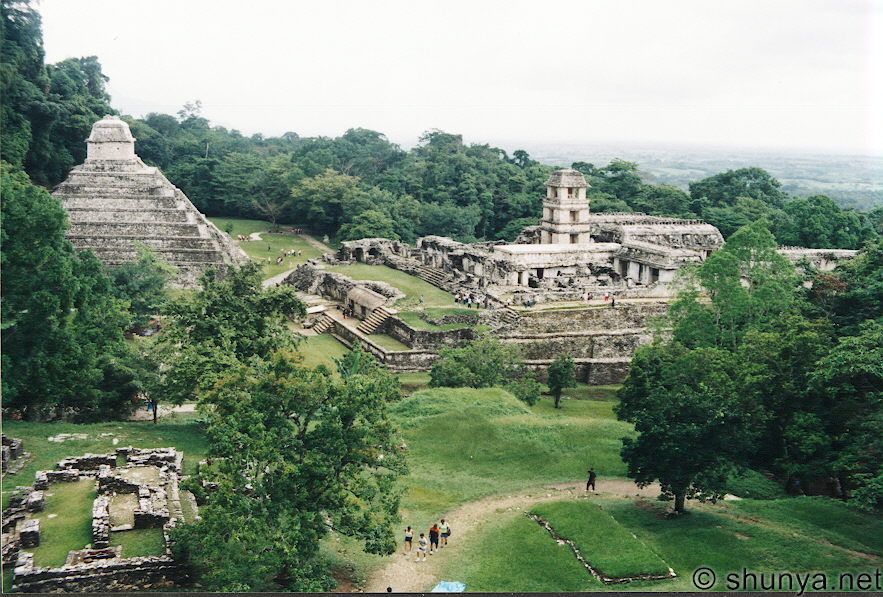
Giant mahogany and ceiba trees are prevalent, while lesser plant forms spill from their branches with unbridled luxuriance. A plethora of animal life is also supported. Common insects include leaf-cutter ants, fire-flies and grasshoppers. Howler-monkeys and spider-monkeys are prolific, as are toucans, frogs and rodents. Less common, though reputedly present, are jaguars, tapirs and pumas.

Ceremonial Center
Palenque’s ceremonial centre is the city’s most architecturally impressive. Here one finds the exquisite Temple of Inscriptions, a nine-tiered pyramid erected by King Pacal in the 7th Century AD. The building derives its name from a series of hieroglyphic tablets discovered in the temple at its summit – some of the best surviving examples of Mayan writing. It is believed that the inscriptions describe the history of Palenque’s ruling elite.
Nearby stands the ‘Palace’. This fortress-like building, which was added to by several different rulers, is one of the city's most famous. Crumbling walls and terraces conceal a large, inner courtyard. Inside, gruesome stone carvings depict prisoners tied and bound at the hands and ankles. Beneath the building, a labyrinthine network of tunnels reaches through the foundations. The Palace’s most unusual feature is a square observation tower believed to have been used for astronomical purposes.
The real jewel of Palenque is a collection of three temples known as the ‘Group of the Cross’. Constructed under Pacal's son, King Chan-Bahlam, in the 8th Century AD, these temples contain superior stone carvings. Each structure bears a series of panels which depict the king on a cosmic journey. The scenes grow increasingly sacred as one advances inside. The most sacred carvings show Chan Bahlam meeting his father in the underworld. There he receives the kinds of supernatural powers necessary to rule the city.
Consuming Darkness
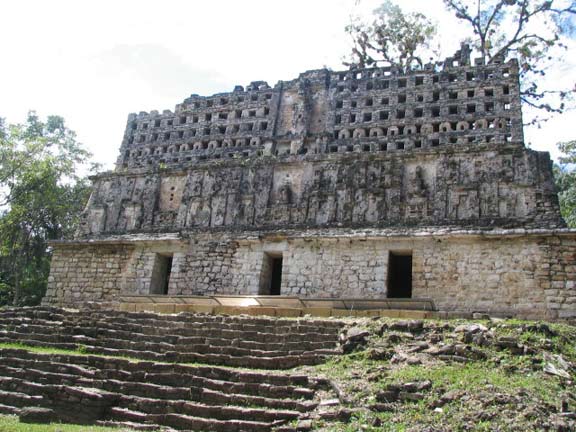
Beyond the well-groomed ceremonial centre, paths lead into the consuming darkness of the jungle. There the growth is rampant and enveloping. The ancient buildings are crumbling and unrestored. Roots twist around blackened blocks, shattering terraces and splitting walls. The paths take twisting routes into it, descending plateaux precariously, ascending faces haphazardly.
Little wooden bridges cross over streams, passing sublime waterfalls and ethereal natural spaces. There is an undeniably magical quality to this side of Palenque. Something the locals might call ‘encanto’ - ‘enchanted’ or sacred. Palenque’s museum lies at the end of the main trail. Visitors can expect to see superlative exhibitions on ancient Mayan culture. Worship, human sacrifice, trade, astronomy, art, mathematics and other aspects of their daily life are explored through a stunning collection of artifacts.
The Maya were an undeniably astute race, and the city of Palenque is testament to a civilisation at its height. Never again would the Maya achieve so much in the spheres of science, art and architecture. In short, Palenque is a product of a Mayan Golden Age. Visit this museum to learn about the place of this city in the wider context of Mayan history and evolution.

King Pacal's Sarcophagus
In 1952, archaeologists discovered a man-made tunnel reaching inside the Temple of Inscriptions. When eventually they cleared it of rubble, they found a chamber containing a beautifully carved sarcophagus. Beneath its heavy stone lid lay the millennia old remains of King Pacal himself. It seems that the Temple of Inscriptions was his funerary monument.
Today, visitors can descend this tunnel and see the world-famous sarcophagus for themselves. The image on its lid shows King Pacal descending into the jaws of the earth monster. Note that visitors will need written permission from the site office. Entry to the tomb is in the afternoon, when the main site has closed. Flash photography is prohibited.

Current Research
Dr. Ed Barnhart of the Mayan Exploration Center, who has directed a three-year project to map the entire city's layout, says the buildings were designed to achieve certain effects at different times of the year, which the MEC scientists have studied using laser technology and stop-motion cameras.
At the vernal and autumnal equinoxes, light from the sunset is focused into a beam that strikes the farthest corners of the inner chambers. During the summer solstice, the scenes in the central chambers become illuminated.
Barnhart says these effects were used to time agricultural actions and public rituals. He says archaeoastronomy, the study of the interaction between ancient architecture and celestial events, offers insights into Mayan architecture at sites throughout the empire, which stretched as far as Western Honduras.
"This is really the future of Mayan studies," he says. "We're beginning to suspect that many other cities could contain similar features."
In addition to archaeoastronomy, MEC scientists are conducting research into sacred geometry, uncovering the mathematical rules by which the Maya constructed their temples. It seems there is much yet to be discovered about this ancient civilization. The mystery and allure of their world is as profound as ever.
 Posted in:


0 comments:
Post a Comment